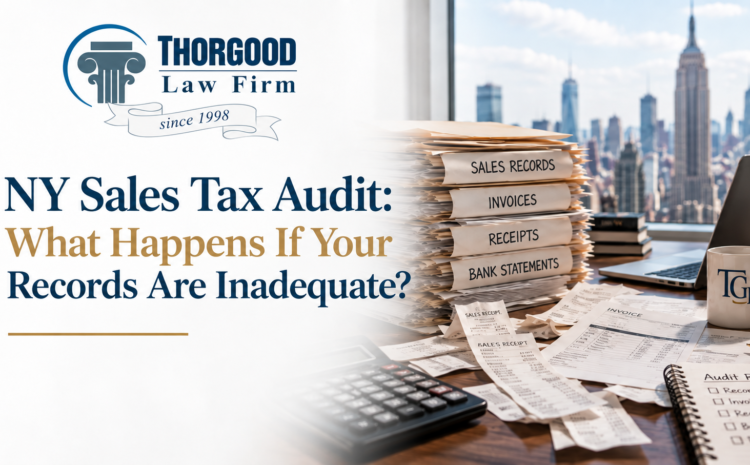
If your New York business is undergoing a sales tax audit, one of the most important questions may be whether the auditor considers your books and records adequate.
Why does that matter?
Because when a business has adequate records, the New York State Department of Taxation and Finance generally can determine sales tax liability from the business’s actual transactions. But if the Department determines that the records are inadequate, it may use an estimated audit methodology to calculate taxable sales and additional tax.
That can dramatically change an audit.
Instead of determining liability from what your business actually recorded, an auditor may use purchases, markup percentages, observation tests, credit-card information, statistical sampling, or other indirect methods to estimate taxable sales over the audit period.
The resulting assessment can sometimes be substantially greater than the amount the business owner believes is actually owed.
If a New York sales tax auditor is questioning the adequacy of your records, it is important to understand what the Department is looking for, why the determination matters, and what rights you have to challenge the audit results.
What Records Must a New York Business Maintain?
Businesses registered to collect New York sales tax are required to maintain records sufficient to establish whether they properly reported taxable sales and collected and remitted the appropriate tax.
According to the New York State Department of Taxation and Finance, a sales tax vendor’s records should establish, among other things:
- total sales;
- taxable sales;
- purchases subject to tax on which tax was not paid;
- credits;
- sales and use tax due for each jurisdiction; and
- other applicable special taxes.
The records must contain enough detail to independently determine the taxable status of individual sales and the amount of sales tax due and collected.
Depending on the type of business, records may include invoices, receipts, sales slips, contracts, cash register tapes, purchase invoices, bank records, credit-card processing records, exemption certificates, resale certificates, general ledgers, and point-of-sale data.
Businesses generally must retain sales tax records for at least three years from the due date of the return to which they relate or the date the return was filed, if later.
When Can Records Be Considered Inadequate?
Having some records does not necessarily mean that a business has adequate records for purposes of a New York sales tax audit.
The Department’s current guidance identifies several circumstances in which records may be considered inadequate.
For example, records may be inadequate if they:
- do not verify sales receipts;
- do not establish whether receipts are taxable;
- fail to provide details of individual transactions;
- do not verify the taxable status of purchases;
- do not demonstrate a reasonable relationship between purchases and sales;
- do not permit the auditor to conduct a complete audit;
- are not made available to the auditor;
- are not maintained in a form that can be audited; or
- lack adequate internal controls necessary to establish the accuracy and completeness of recorded transactions.
This means that simply producing tax returns, bank statements, or summary sales reports may not necessarily be enough.
The Department specifically cautions that summary reports and daily summary or “Z” tapes alone do not provide the individual transaction detail required to substantiate sales.
POS Records Can Become Particularly Important
Many businesses assume that because they use a modern point-of-sale system, their sales records will automatically be considered adequate.
That is not necessarily the case.
New York requires businesses using POS systems to maintain auditable internal controls that allow transactions to be traced from the original source through the final reported totals.
The Department’s current guidance states that POS records should include information such as sequential transaction numbers, records of terminal activity, and procedures accounting for voids, cancellations, and discrepancies.
Audit-trail or logging functions generally must remain activated and operational. The Department also expects electronic records to be maintained in an electronically readable form.
This can create problems when a business changes POS providers, deletes historical transaction data, retains only daily summary reports, fails to preserve information concerning voids or canceled transactions, or cannot retrieve the underlying transaction-level data for the audit period.
A business owner may believe the records are complete because monthly or daily sales totals remain available. The auditor may reach a very different conclusion if the underlying transactions cannot be examined.
Why Does an Inadequate-Records Finding Matter?
This is where the issue becomes especially important.
When adequate books and records exist, the Department generally should determine sales tax liability from those records.
When records are inadequate, however, New York Tax Law permits the Department to estimate the amount of tax due using an audit methodology reasonably calculated to determine the taxpayer’s sales tax liability.
The Department’s own Publication 900 explains that if auditors properly request and evaluate the business’s records and determine that they are inadequate, they may use an estimated audit method reasonably designed to calculate state and local sales tax liability.
That can shift the audit away from the business’s actual recorded sales and toward an indirect reconstruction of what the Department believes the business sold.
How Can New York Estimate Your Sales?
There is no single estimated audit method that applies to every business.
The methodology depends on the nature of the business and the information available to the auditor.
For example, an auditor may examine purchases and apply a markup percentage to estimate gross sales.
In a restaurant audit, the Department might examine purchases of food and beverages and attempt to determine how those purchases translate into retail sales.
An auditor may also conduct an observation test to estimate the relationship between cash and credit-card sales or other aspects of the business’s operations.
Other audits may involve statistical sampling, credit-card information, third-party records, or comparisons between purchases, bank deposits, reported gross receipts, and reported taxable sales.
Once the Department resorts to an indirect methodology, relatively small assumptions can become significant because the results may be projected over multiple sales tax quarters.
That is why the adequacy-of-records determination can have such a large financial impact.
Can the Auditor Estimate Sales Just Because the Records Are Imperfect?
Not every recordkeeping defect necessarily gives the Department unlimited authority to disregard the taxpayer’s actual records.
Whether the Department was entitled to resort to an estimated methodology can itself become an important issue in a sales tax controversy.
The initial question is generally whether the taxpayer maintained and produced records sufficient to allow the Department to conduct a complete audit and verify taxable sales.
A business facing an inadequate-records determination should therefore examine:
- exactly what records the auditor requested;
- what records the business actually maintained;
- what was produced;
- whether additional records exist;
- whether the records can be reconciled;
- whether transaction-level data can be recovered;
- whether the Department adequately examined the available records; and
- why the auditor concluded that a detailed audit could not be performed.
Do not automatically accept an auditor’s statement that the books and records are inadequate without understanding the basis for that conclusion.
What If Some Records Are Missing?
Missing records are serious, but they do not necessarily mean that the business should give up and accept whatever estimate the auditor proposes.
The first step should be determining what can be reconstructed.
Depending on the circumstances, useful information may be available from:
- banks;
- credit-card processors;
- POS providers;
- accountants and bookkeepers;
- vendors and suppliers;
- payroll providers;
- online ordering platforms;
- merchant processors;
- customer invoices;
- inventory records; and
- prior tax-return workpapers.
If records can be recovered, reconstructed, or reconciled, they may help demonstrate the business’s actual sales or challenge assumptions used in an estimated audit.
The earlier this work begins, the better.
Can You Challenge the Auditor’s Estimated Method?
Yes.
An estimated assessment is not automatically correct merely because the Department was entitled to use an indirect methodology.
The methodology still must have a rational basis and be reasonably calculated to determine the tax due.
However, challenging an estimated sales tax assessment can be difficult.
Once the Department establishes that the taxpayer’s records were inadequate and that its audit method was reasonable, the taxpayer can face a substantial burden in demonstrating that the methodology or resulting assessment was erroneous.
That makes it important to challenge questionable assumptions during the audit rather than waiting until the assessment has become final.
For example, depending on the methodology used, questions might include:
- Was the markup percentage representative of the business?
- Were purchases properly categorized?
- Did the auditor account for waste, spoilage, theft, discounts, or complimentary items?
- Was the observation period representative?
- Were unusual business conditions ignored?
- Were nontaxable transactions included?
- Was a short test period improperly projected across substantially different periods?
- Were credit-card transactions counted correctly?
- Did the auditor use comparable periods?
- Were mathematical or factual errors made?
The answers can materially affect the proposed assessment.
What Penalties Can Result From Inadequate Records?
Inadequate records can create consequences beyond additional tax.
The Department warns that businesses with inadequate records may face an estimated audit methodology, penalties and interest on additional tax, possible criminal penalties for willful failure to maintain required records, and potential suspension or revocation of the business’s Certificate of Authority.
There are also specific penalties relating to the failure to make required records available in an auditable or electronic form.
This is another reason not to treat a recordkeeping dispute as merely an administrative inconvenience.
In serious cases, the consequences can affect both the amount of the assessment and the business’s ability to continue operating.
Does Having Inadequate Records Mean You Committed Tax Fraud?
No.
Poor recordkeeping does not automatically mean tax fraud.
Businesses can have incomplete records for many reasons. Records may have been lost, accounting systems may have changed, a prior bookkeeper may have failed to preserve information, POS data may no longer be readily accessible, or the owner may simply have misunderstood New York’s detailed recordkeeping requirements.
There is an important distinction between inadequate records and intentional falsification or concealment of sales.
Nevertheless, an audit can become more serious if the Department discovers evidence suggesting deliberate destruction of records, intentionally unreported sales, fabricated documents, false exemption certificates, or other willful conduct.
If an auditor’s questions suggest potential fraud or criminal exposure, the business owner should consider speaking with a tax attorney before providing additional statements or documents.
Should You Hire a Tax Attorney If the Auditor Says Your Records Are Inadequate?
Not every New York sales tax audit requires an attorney.
But an inadequate-records determination is a point at which obtaining legal advice should be seriously considered, particularly if the potential assessment is substantial.
A tax attorney can evaluate whether the Department has a proper basis for rejecting the records, review the proposed audit methodology, identify weaknesses in the auditor’s assumptions, assist with reconstructing relevant information, and communicate with the Department on the taxpayer’s behalf.
Representation may be especially important when the audit involves:
- substantial estimated assessments;
- cash-intensive businesses;
- restaurants, bars, or retail establishments;
- missing POS records;
- significant differences between reported sales and bank or credit-card information;
- collected but unremitted sales tax;
- potential responsible-person liability; or
- allegations suggesting fraud or intentional misconduct.
What Should You Do If Your Records Are Inadequate?
Do not assume that the outcome of the audit has already been determined.
First, identify precisely what the auditor believes is missing or inadequate.
Next, determine whether additional records exist or can be reconstructed from third parties. Reconcile the available information and understand any differences before submitting additional material.
If the Department proposes an indirect audit methodology, examine the assumptions carefully.
Most importantly, do not wait until a large Notice of Determination has been issued before addressing problems with the audit methodology.
An inadequate-records determination can dramatically increase the stakes of a New York sales tax audit, but taxpayers still have rights.
Speak With a New York Sales Tax Audit Attorney
If the New York State Department of Taxation and Finance has determined that your business records are inadequate—or is proposing an estimated sales tax assessment—you should understand the potential consequences before agreeing to the auditor’s findings.
At Thorgood Law Firm, we represent businesses and individuals in New York State sales tax audits, disputes involving estimated audit methodologies, challenges to sales tax assessments, responsible-person liability, tax appeals, and matters involving potential civil or criminal tax exposure.
If you are facing a New York sales tax audit involving inadequate or incomplete records, contact Thorgood Law Firm to discuss your situation.
Frequently Asked Questions
What does New York consider inadequate records in a sales tax audit?
Records may be considered inadequate when they do not verify sales receipts, establish which sales are taxable, contain sufficient individual transaction detail, substantiate purchases, correlate purchases with sales, or otherwise allow the Department to conduct a complete audit. Failure to make records available or maintain them in an auditable form can also create problems.
Can New York estimate my sales if my records are incomplete?
Yes. If the Department properly determines that a business’s records are inadequate, it may use an estimated or indirect audit methodology reasonably calculated to determine sales tax liability.
What methods can New York use to estimate sales?
Depending on the business and available information, methods may involve purchase markups, observation tests, statistical sampling, credit-card information, third-party records, or other indirect evidence of sales.
Are daily POS summaries or Z tapes enough for a New York sales tax audit?
Not necessarily. New York’s current guidance specifically states that summary reports and daily summary or “Z” tapes do not by themselves provide the required detail of individual transactions. POS systems should preserve sufficient transaction-level information and an auditable trail.
Can I challenge an estimated New York sales tax assessment?
Yes. A taxpayer may challenge whether the Department was entitled to use an estimated methodology and, depending on the circumstances, whether the methodology and resulting assessment were reasonable. These disputes are highly fact-specific.
What if my POS system no longer contains records from the audit period?
Determine whether the historical data can be recovered from the POS provider, backups, accountants, merchant processors, or other sources. New York requires electronic sales records to be retained and made available in an auditable form, so missing historical POS data can create significant audit issues.
Can inadequate sales records result in penalties?
Yes. Inadequate records can result in estimated additional tax, penalties and interest. New York also provides specific penalties for certain failures to maintain or produce required records and warns that willful recordkeeping violations can potentially have criminal consequences.
Does inadequate recordkeeping mean I committed sales tax fraud?
No. Inadequate records alone do not establish fraud. However, evidence of intentional concealment of sales, falsified records, deliberately destroyed records, or similar willful conduct may create more serious civil or criminal issues.
Should I hire an attorney if the sales tax auditor rejects my records?
Consider obtaining legal advice when the auditor’s inadequate-records determination may lead to a substantial estimated assessment, particularly where the audit involves cash sales, missing POS records, personal liability, unremitted tax, or possible fraud allegations.