
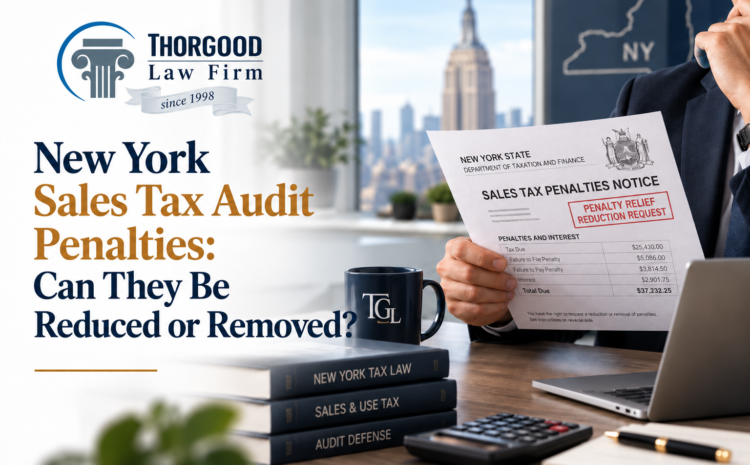
A New York sales tax audit can result in more than an assessment of additional tax.
The New York State Department of Taxation and Finance may also impose penalties and interest, sometimes adding a substantial amount to the total liability.
For a business already facing a large audit assessment, those additions can be significant.
The good news is that some New York sales tax penalties can potentially be reduced or removed. New York law permits penalty relief in appropriate cases where the taxpayer can establish reasonable cause and the absence of willful neglect.
But penalty abatement is not automatic.
A taxpayer generally must demonstrate why the failure occurred, what steps were taken to comply with the law, and why the circumstances justify relief. Simply saying that the mistake was unintentional or that the business acted in good faith may not be enough.
If you are facing penalties following a New York sales tax audit, it is important to understand what penalties may apply, what constitutes reasonable cause, and what evidence can support a request for abatement.
What Penalties Can Result From a New York Sales Tax Audit?
New York Tax Law § 1145 contains a number of penalties relating to sales and use tax.
One of the most common applies when a taxpayer fails to file a required return or fails to pay or pay over sales tax within the required time.
Under Tax Law § 1145(a)(1), the basic penalty generally begins at 10% of the tax due for the first month, with an additional 1% for each additional month or part of a month, up to a maximum of 30%.
Interest is also imposed on unpaid tax.
That means a taxpayer facing a large audit assessment may owe:
- additional sales tax;
- civil penalties; and
- interest accruing on the unpaid tax.
For example, if an audit results in $200,000 of additional tax, penalties can add tens of thousands of dollars to the liability before interest is considered.
Can New York Waive Sales Tax Penalties?
Yes, in appropriate circumstances.
Tax Law § 1145(a)(1)(iii) authorizes the Commissioner to waive certain penalties where the taxpayer establishes that the failure was due to reasonable cause and not due to willful neglect.
This is the central standard for many sales-tax penalty-abatement requests.
But the taxpayer bears the burden of establishing reasonable cause.
New York courts have repeatedly emphasized that penalty relief is not granted simply because the taxpayer states that the mistake was innocent.
The taxpayer should be prepared to establish the facts with credible documentation and, where appropriate, testimony.
What Is “Reasonable Cause”?
There is no single definition that applies automatically to every case.
New York’s regulations recognize that reasonable cause depends upon the particular facts and circumstances.
The Department’s reasonable-cause regulations, contained in 20 NYCRR Part 2392, were designed to provide a consolidated framework for determining when penalties may be abated. They recognize, among other things, that certain situations involving reliance on professional advice, honest misunderstandings of fact or law, or other circumstances may potentially establish reasonable cause.
The important point is that reasonable cause generally requires more than simply proving that the taxpayer did not intend to violate the law.
The taxpayer usually must demonstrate that it exercised ordinary business care and prudence but nevertheless failed to comply.
Can Reliance on an Accountant Be Reasonable Cause?
Sometimes.
Businesses frequently rely on accountants, bookkeepers, payroll companies, and other tax professionals.
A taxpayer might argue:
“My accountant told me these transactions were not taxable.”
or:
“My accountant prepared the sales tax returns incorrectly.”
Professional reliance can potentially support reasonable cause, but merely hiring an accountant does not automatically eliminate penalties.
The taxpayer should generally be able to demonstrate that:
- the professional was competent to advise on the issue;
- the taxpayer provided complete and accurate information;
- the taxpayer actually relied on the professional advice;
- the advice concerned the particular tax issue involved; and
- the taxpayer’s reliance was reasonable under the circumstances.
The taxpayer may also need evidence showing what advice was actually given.
Emails, memoranda, engagement letters, written opinions, correspondence, or testimony may become important.
A generalized assertion that “my accountant handled everything” may be insufficient.
What If the Business Misunderstood the Sales Tax Law?
A genuine misunderstanding of the law can sometimes support penalty relief, but ignorance of the law by itself is generally not enough.
This distinction is important.
In Matter of Zuckerman v. Tax Appeals Tribunal, 174 A.D.3d 1073 (3d Dep’t 2019), the Third Department reiterated that neither ignorance of the law nor merely advancing a reasonable legal theory establishes reasonable cause without evidence that the taxpayer made efforts to determine the proper tax liability.
In other words, the question may be:
What did the business do to determine whether sales tax applied?
Did the business:
- consult a tax professional?
- research Tax Department guidance?
- request advice?
- review regulations?
- seek a written ruling?
- consistently follow professional guidance?
- attempt to correct the issue once discovered?
Those facts can matter.
A business that made a reasonable effort to determine its obligations may be in a stronger position than a business that simply assumed sales tax did not apply.
Can Financial Hardship Be Reasonable Cause?
Financial hardship alone does not necessarily establish reasonable cause for failing to remit sales tax.
This is particularly important where the business actually collected sales tax from customers.
New York treats collected sales tax as money held in trust for the State. A business that uses those funds to pay payroll, rent, vendors, or other creditors may still be liable for the tax and penalties.
The fact that the business was struggling financially may explain why the money was not paid, but that explanation does not automatically require the Department to waive penalties.
The taxpayer should therefore be cautious about relying solely on:
“We didn’t have the money.”
A stronger reasonable-cause submission usually requires more detailed facts and circumstances.
What About Serious Illness or Other Circumstances Beyond the Taxpayer’s Control?
Circumstances outside the taxpayer’s control may potentially support reasonable cause.
For example, depending upon the facts, relevant circumstances might include:
- serious illness;
- death of a key individual;
- destruction of records;
- natural disaster;
- unavoidable absence;
- significant system failure; or
- other extraordinary circumstances that prevented timely compliance.
Again, documentation is important.
Medical records, insurance documentation, disaster records, system reports, correspondence, and other evidence may be necessary to establish both the event and its connection to the failure to comply.
The taxpayer should also be able to show that it acted reasonably once the problem was discovered or the extraordinary circumstance ended.
Does a Computer or Software Error Qualify?
Potentially—but the taxpayer must prove it.
In Matter of Luongo v. Tax Appeals Tribunal, the taxpayer argued that sales tax was undercollected because of a computer-programming error.
The Third Department upheld the penalties because that explanation was unsupported by documentary evidence, and the taxpayer failed to explain other deficiencies unrelated to the alleged programming problem.
That case illustrates an important principle:
An explanation is not the same thing as evidence.
If a business claims that a POS system, accounting program, or tax software caused the error, it should be prepared to show:
- what went wrong;
- when the error occurred;
- how the error affected the tax calculation;
- whether the business reasonably relied on the system;
- what steps were taken to detect errors; and
- what corrective action was taken once the problem was identified.
Technical reports, correspondence with software vendors, screenshots, system logs, or testimony may help substantiate the claim.
Can Penalties Be Reduced Even If the Tax Is Correct?
Yes.
The underlying tax and the penalty are separate issues.
A taxpayer may agree that additional sales tax is due while still arguing that penalties should be abated.
For example, suppose a business concedes that it mistakenly failed to collect tax on a particular service.
The business may still argue:
“We accept the tax adjustment, but the penalty should be removed because we reasonably relied on professional advice and did not willfully neglect our obligations.”
That can be an important strategy.
Challenging every dollar of tax is not always necessary to obtain meaningful relief.
What If the Auditor Imposes Penalties Automatically?
A taxpayer should not assume that the penalty determination is beyond challenge simply because it appears on the audit calculation.
Ask the auditor:
What specific penalty is being imposed?
Under what statutory provision?
For which periods?
How was it calculated?
Is reasonable-cause relief available?
Then determine whether the facts support abatement.
A written penalty-abatement request can often be submitted during the audit or later in the administrative process.
The Department also permits authorized tax professionals to submit penalty-waiver requests through its online services.
What Evidence Helps Support Penalty Abatement?
A strong penalty-abatement request should generally be supported by facts and evidence rather than conclusory statements.
Depending on the case, useful evidence may include:
- correspondence with accountants or attorneys;
- written tax advice;
- engagement letters;
- tax research;
- prior audit history;
- Department publications relied upon;
- emails concerning the tax treatment;
- computer or POS system records;
- medical or emergency documentation;
- internal compliance procedures;
- training materials;
- proof of corrective action;
- amended returns;
- evidence of voluntary disclosure; and
- records showing a history of timely tax compliance.
The goal is to demonstrate why the failure occurred and why the taxpayer acted reasonably despite the failure.
Does a Good Compliance History Matter?
It can.
A business that has consistently filed returns and paid sales tax correctly for many years may have a stronger equitable presentation than a taxpayer with repeated compliance problems.
However, New York sales tax penalty relief is not identical to the IRS’s federal First-Time Abatement program.
Taxpayers should not assume that New York automatically removes a sales-tax penalty simply because the business had no prior violations.
A good compliance history may support the reasonable-cause analysis, but the taxpayer generally still needs to address the specific failure that caused the penalty.
What About Fraud Penalties?
Fraud penalties are much more serious.
Tax Law § 1145(a)(2) provides that where a failure to pay or pay over sales tax is due to fraud, the taxpayer may be subject to a penalty equal to two times the amount of tax due, in addition to interest.
That is dramatically different from the ordinary delinquency penalty.
For example:
If the underlying tax deficiency is $250,000, a fraud penalty could potentially add $500,000, before considering interest.
The distinction between negligence, reasonable error, and fraud therefore matters enormously.
Fraud generally requires proof of intentional wrongdoing rather than mere mistake.
Issues may include whether the taxpayer:
- deliberately concealed sales;
- maintained false records;
- knowingly filed false returns;
- destroyed or manipulated POS data;
- concealed bank accounts;
- intentionally failed to report cash transactions; or
- engaged in other conduct indicating intentional tax evasion.
If the auditor begins suggesting fraud, the taxpayer should take the matter very seriously.
Can Fraud Penalties Be “Abated” Based on Reasonable Cause?
This is fundamentally different from an ordinary delinquency penalty.
If the Department properly establishes fraud, the ordinary reasonable-cause analysis does not simply erase the fraud penalty.
The taxpayer may instead need to challenge whether fraud has been established at all.
That makes the evidence of intent particularly important.
A business may acknowledge errors or even substantial underpayments while disputing the Department’s claim that those errors were fraudulent.
Can New York Sales Tax Penalties Lead to Criminal Issues?
Potentially.
Civil penalties and criminal charges are different, but the same facts may sometimes raise both issues.
New York’s Tax Law contains separate criminal tax-fraud provisions.
Conduct such as intentionally concealing sales, knowingly filing materially false tax returns, supplying false information during an audit, or willfully failing to remit collected sales tax can potentially create criminal exposure.
A business owner should therefore be cautious if the auditor’s penalty discussion shifts from ordinary negligence or delinquency toward allegations of fraud, intentional concealment, or willful misconduct.
Can You Challenge Penalties After a Notice of Determination?
Yes, provided the taxpayer acts within the applicable statutory deadline.
A New York sales tax Notice of Determination generally may be challenged through the administrative appeal process.
A taxpayer may seek a conciliation conference through the Bureau of Conciliation and Mediation Services or file a petition with the New York State Division of Tax Appeals.
The penalty issue can be raised along with challenges to the underlying tax assessment.
The 90-day deadline applicable to sales tax Notices of Determination is extremely important.
A taxpayer should not allow the protest deadline to expire while continuing informal discussions about penalty relief.
What Should a Penalty-Abatement Request Explain?
A persuasive request should tell a clear factual story.
It should generally explain:
- What happened?
- Why did it happen?
- Why was the failure reasonable under the circumstances?
- What steps did the taxpayer take to comply?
- What evidence supports those facts?
- What was done to correct the problem?
- Why is the problem unlikely to recur?
The request should also address facts that appear unfavorable rather than ignoring them.
A carefully supported reasonable-cause argument is generally stronger than a broad statement that the business “acted in good faith.”
When Should You Speak With a New York Sales Tax Attorney?
Consider obtaining legal advice when:
- the penalties are substantial;
- the auditor has asserted fraud;
- collected sales tax was not remitted;
- multiple tax periods are involved;
- the Department claims that records were intentionally inaccurate;
- owners or officers face personal liability;
- the taxpayer relied on professional advice;
- an estimated audit produced a large assessment;
- a Notice of Determination has been issued; or
- criminal exposure may exist.
A tax attorney can analyze both the underlying assessment and whether there is a basis to reduce or eliminate penalties.
Speak With a New York Sales Tax Audit Attorney
Sales tax penalties can significantly increase the cost of a New York audit, but taxpayers should not assume that every penalty imposed by the Department must be accepted.
At Thorgood Law Firm, we represent businesses and individuals in New York State sales tax audits, penalty-abatement disputes, estimated audit cases, responsible-person assessments, administrative appeals, and matters involving potential civil fraud or criminal tax exposure.
If your New York sales tax audit includes substantial penalties, contact Thorgood Law Firm to discuss whether the penalties can be challenged, reduced, or removed.
Frequently Asked Questions
Can New York sales tax audit penalties be waived?
Yes, certain penalties may be waived where the taxpayer establishes that the failure was due to reasonable cause and not due to willful neglect. Whether reasonable cause exists depends on the particular facts and supporting evidence.
What is the normal penalty for failing to pay New York sales tax?
Under Tax Law § 1145, the ordinary delinquency penalty generally begins at 10% of the tax due for the first month, plus 1% for each additional month or fraction of a month, up to a maximum of 30%. Interest also accrues.
What is reasonable cause for New York sales tax penalty relief?
Reasonable cause is determined from the facts and circumstances. Potential grounds can include reasonable reliance on professional advice, certain honest misunderstandings of fact or law, serious circumstances beyond the taxpayer’s control, or other situations showing that the taxpayer exercised reasonable care but nevertheless failed to comply.
Can relying on an accountant eliminate sales tax penalties?
Potentially, but not automatically. A taxpayer generally should demonstrate that the professional was qualified, received complete and accurate information, provided advice concerning the issue, and that the taxpayer reasonably relied upon that advice.
Is financial hardship reasonable cause for failing to pay sales tax?
Financial hardship alone does not automatically establish reasonable cause, particularly where the business collected sales tax from customers and used the funds for other expenses.
Can a computer or POS error support penalty abatement?
Potentially. However, the taxpayer should be able to document the error, explain how it affected sales tax reporting, and establish that the taxpayer acted reasonably in using and monitoring the system.
Can I get penalties removed even if I agree that additional tax is due?
Yes. Tax and penalties are separate issues. A taxpayer may concede some or all of the additional tax while independently seeking penalty abatement based on reasonable cause.
What is the New York sales tax fraud penalty?
Where a failure to pay or pay over sales tax is due to fraud, Tax Law § 1145 provides for a penalty equal to two times the amount of tax due, in addition to interest.
How do I challenge sales tax penalties after a Notice of Determination?
A taxpayer may challenge penalties through New York’s administrative protest procedures, including a conciliation conference or a petition to the Division of Tax Appeals. A sales tax Notice of Determination generally carries a 90-day protest deadline.