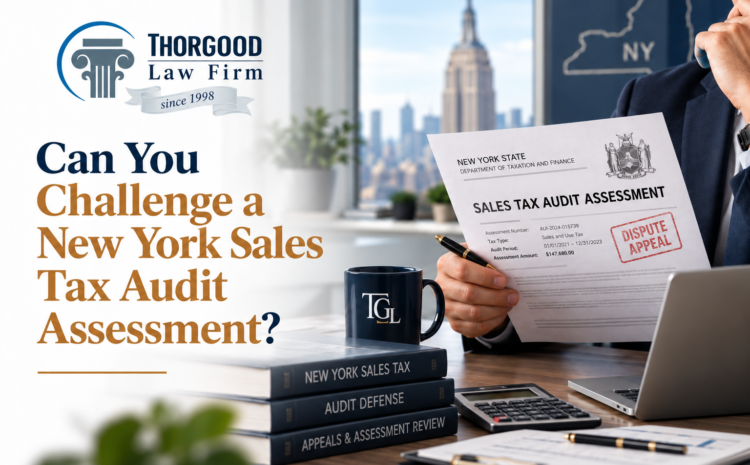
A New York sales tax audit can end with an assessment substantially larger than a business owner expected.
The auditor may claim that your business underreported taxable sales, improperly treated transactions as exempt, failed to collect sales tax, maintained inadequate records, or failed to remit sales tax that was collected from customers.
In some audits, the New York State Department of Taxation and Finance may estimate sales using purchase markups, observation tests, statistical sampling, credit-card information, or other indirect methods.
But an auditor’s determination is not necessarily the final word.
New York taxpayers have rights to dispute sales tax audit findings. Depending on where you are in the process, you may be able to challenge the auditor’s conclusions during the audit, protest a Notice of Determination administratively, and ultimately seek judicial review of an adverse Tax Appeals Tribunal determination.
The important point is to act early.
Once a Notice of Determination is issued, strict deadlines apply. Tax Law § 1138 generally provides 90 days to challenge a sales tax Notice of Determination. If the deadline is missed, the assessment generally becomes fixed.
Understanding what can be challenged, how to challenge it, and what evidence is necessary can make an enormous difference.
You Do Not Have to Wait Until the Audit Is Over to Dispute It
The best time to challenge a questionable sales tax assessment may be before the Department issues a Notice of Determination.
During the audit, the auditor should explain proposed adjustments and the basis for the additional tax.
That creates an opportunity to examine the auditor’s calculations and identify problems.
Depending upon the audit, questions may include:
- Did the auditor misunderstand how the business operates?
- Were nontaxable transactions treated as taxable?
- Were valid exemption or resale certificates disregarded?
- Were bank deposits incorrectly treated as sales?
- Did the auditor use an incorrect markup percentage?
- Was an observation period unrepresentative?
- Were credit-card tips treated as business receipts?
- Did the auditor fail to account for waste, spoilage, discounts, or complimentary items?
- Were transactions counted twice?
- Were calculations projected across periods when business conditions were materially different?
Resolving these issues while the audit remains open can sometimes reduce the proposed assessment without requiring formal litigation.
What Happens If You Disagree With the Auditor?
If the disagreement cannot be resolved during the audit, the Department may issue a Notice of Determinationassessing additional tax, penalties, and interest.
At that point, the dispute becomes much more formal.
Tax Law § 1138 provides that, after 90 days from the mailing of a Notice of Determination, the notice becomes an assessment except for amounts that the taxpayer timely challenges through the administrative hearing process.
That makes the date on the notice extremely important.
Do not assume that continuing discussions with the auditor will extend the statutory protest deadline.
If you receive a Notice of Determination, determine the deadline immediately.
How Can You Challenge a New York Sales Tax Assessment?
A taxpayer generally has two principal administrative avenues for contesting a New York sales tax determination.
One is to request a conciliation conference through the Bureau of Conciliation and Mediation Services, commonly known as BCMS.
The other is to file a petition with the New York State Division of Tax Appeals requesting a hearing before an Administrative Law Judge.
These procedures are different, and determining which route is appropriate can depend upon the circumstances of the case.
A taxpayer considering either option should evaluate the strength of the underlying evidence, the amount at issue, the audit methodology, potential penalties, and whether legal issues rather than merely factual disagreements are involved.
What Can You Challenge?
A sales tax assessment can potentially be challenged on several grounds.
- The Transactions Were Not Taxable
Sometimes the dispute concerns the legal question of whether the business’s products or services were subject to sales tax at all.
New York imposes sales tax on specified transactions. Not every service or receipt is taxable.
A business may therefore argue that the Department incorrectly classified particular transactions as taxable.
These disputes can turn on statutory language, regulations, administrative guidance, contracts, invoices, and the actual nature of the service or property being sold.
Taxability disputes should be distinguished from disputes over whether taxable sales were accurately reported.
- The Business Had Adequate Books and Records
This can be a critical issue.
New York requires sales tax vendors to maintain records sufficient to verify their taxable sales.
Where adequate records exist and are produced, the Department generally must use them rather than simply disregard them in favor of an estimated methodology.
The Third Department explained in Matter of Hwang v. Tax Appeals Tribunal, 105 A.D.3d 1151 (3d Dep’t 2013), that adequate taxpayer records must be utilized and that the Department cannot simply ignore them.
Similarly, Matter of Zuckerman v. Tax Appeals Tribunal, 174 A.D.3d 1073 (3d Dep’t 2019), explains that the Department must request appropriate records and sufficiently investigate them to determine whether the materials can support a complete audit before resorting to estimation.
Accordingly, one possible challenge is:
Was the Department entitled to estimate the tax in the first place?
- The Estimated Audit Method Was Unreasonable
If the taxpayer’s records are inadequate, Tax Law § 1138 permits the Department to determine tax using available information and, when necessary, external indices such as purchases, inventory, rent, number of employees, location, or other relevant factors.
But that does not mean every estimate is automatically correct.
A taxpayer can potentially challenge the methodology itself.
For example, an auditor may estimate restaurant sales using purchases and an assumed markup percentage.
Questions might include:
Was the markup representative of the business?
Did the auditor use the correct product mix?
Were changes in menu prices considered?
Did the auditor account for waste or spoilage?
Were employee meals or complimentary items considered?
Was the same markup improperly applied across substantially different products?
Similarly, an observation test may be challenged if the selected period did not fairly reflect ordinary business operations.
- The Auditor’s Calculations Were Wrong
Sometimes the problem is not the overall methodology but how it was applied.
A taxpayer should examine the audit workpapers carefully.
Errors can occur in:
- mathematical calculations;
- purchase totals;
- credit-card totals;
- markup computations;
- classification of taxable and exempt transactions;
- projection formulas;
- treatment of tips;
- allocation among jurisdictions;
- test-period calculations; and
- duplication of transactions.
An estimated audit involving multiple years can magnify relatively small errors.
A mistake affecting a one-week observation period, for example, can become much larger when projected across several years.
- The Auditor Used an Unrepresentative Test Period
Test periods are frequently used in sales tax audits.
New York courts have recognized that test-period methods may be appropriate when a taxpayer’s records are insufficient.
But whether a particular test period fairly represents the business can still be important.
Suppose the auditor selects a period when the business experienced:
- an unusual seasonal spike;
- a major promotion;
- a temporary closure;
- construction nearby;
- a change in management;
- unusual inventory problems; or
- materially different operating conditions.
The taxpayer should consider whether evidence exists showing that the selected period does not reasonably represent the broader audit period.
- Exempt Sales Were Improperly Included
Many sales tax disputes involve exemption documentation.
A business may have made sales for resale or other transactions that were not subject to sales tax but failed to present the supporting documentation effectively during the audit.
Exemption certificates, resale certificates, invoices, contracts, customer information, and other records may become important.
The issue is not simply telling the auditor:
“Those sales were exempt.”
The taxpayer should be prepared to prove why the transactions were exempt.
New York generally places the burden on the person required to collect tax to establish that receipts otherwise presumed taxable were not subject to tax.
- Penalties Should Be Abated
Even where some additional tax is properly due, penalties may still be disputed.
A taxpayer may seek penalty relief where the facts establish reasonable cause and the absence of willful neglect under the applicable standards.
The penalty issue should therefore be analyzed separately from the underlying tax.
A taxpayer might concede a portion of the additional tax while still arguing that penalties should not apply.
Documentation explaining what occurred, what steps the business took to comply, what professional advice was obtained, and how the error arose may become important.
How Difficult Is It to Challenge an Estimated Assessment?
This deserves particular attention.
When the Department properly determines that a taxpayer’s records are inadequate and uses an indirect audit methodology, the taxpayer can face a substantial burden in challenging the resulting assessment.
New York courts generally require the taxpayer to establish by clear and convincing evidence that the audit methodology or resulting assessment was erroneous.
And merely showing that another audit methodology might have produced a more precise result may not be enough.
In Matter of Blackhat Chimney & Fireplace, Inc. v. Tax Appeals Tribunal, 145 A.D.3d 1213 (3d Dep’t 2016), the court reiterated that when the taxpayer’s own failure to maintain proper records prevents exactness, exact precision in the Department’s calculation is not required.
The Third Department reinforced these principles very recently in Matter of Cushlin Ltd. v. Tax Appeals Tribunal, 2026 NY Slip Op 04465. The court held that the taxpayer attacking the assessments had the burden of establishing by clear and convincing evidence that the audit method and resulting assessment were unreasonable. Merely asserting that the methodology was imprecise, without evidence establishing error, was insufficient.
This is why documentation matters so much.
Evidence Is Usually More Powerful Than Argument Alone
A taxpayer should not approach a sales tax appeal as simply an opportunity to tell the auditor or Administrative Law Judge why the assessment seems unfair.
The better approach is to build an evidentiary record.
Depending upon the dispute, useful evidence might include:
- POS transaction data;
- bank records;
- merchant-processing statements;
- purchase invoices;
- inventory records;
- exemption certificates;
- customer invoices;
- accounting records;
- contracts;
- supplier information;
- pricing records;
- menus;
- testimony from owners or employees; and
- expert or accountant analysis.
For example, if the taxpayer argues that the auditor’s markup percentage is unrealistic, actual historical pricing and purchase information may be considerably more persuasive than simply asserting that the percentage is too high.
This distinction is illustrated by the case law. Courts have repeatedly rejected challenges where taxpayers offered assertions about factors such as lower markups, breakage, or other adjustments without sufficient documentary proof.
Can You Appeal an Administrative Law Judge’s Decision?
Yes.
A party dissatisfied with an Administrative Law Judge determination may generally seek review by the New York State Tax Appeals Tribunal.
The Tribunal reviews the administrative record and can affirm, reverse, or modify the determination.
If the taxpayer remains unsuccessful after the Tribunal issues its decision, judicial review may potentially be available through a proceeding in the Appellate Division.
But judicial review is limited.
Courts generally uphold a Tax Appeals Tribunal determination when it has a rational basis and is supported by substantial evidence, even where the record might reasonably support a different conclusion.
That makes the administrative proceeding especially important.
The taxpayer should develop the factual and evidentiary record before reaching judicial review.
What Happens If You Miss the 90-Day Deadline?
This is one of the most dangerous mistakes a taxpayer can make.
Tax Law § 1138 provides that a sales tax Notice of Determination generally becomes an assessment after 90 days unless the taxpayer timely applies for a hearing. For an estimated determination, the statute specifically requires the notice to advise the taxpayer that the estimate may be challenged and that the petition must be filed within 90 days.
Do not put the notice aside while attempting to negotiate informally.
Do not assume that a telephone conversation with the auditor protects your protest rights.
And do not wait until collection begins to decide whether you disagree with the assessment.
The deadline should be identified as soon as the notice is received.
Should You Pay the Assessment Before Challenging It?
Whether payment is appropriate depends upon the procedural posture and circumstances.
A taxpayer generally does not have to concede an assessment merely because the Department issued a Notice of Determination.
Before making strategic decisions about payment, the taxpayer should determine:
- whether the assessment will be challenged;
- what procedural route is available;
- whether only part of the liability is disputed;
- whether penalties are separately contested;
- whether responsible-person assessments have been issued; and
- whether collection activity has begun.
The important point is to distinguish between challenging the liability and resolving an inability to pay.
Those are different problems.
What Should You Do After Receiving a Sales Tax Assessment?
First, identify the deadline.
Second, obtain and review the audit workpapers and determine exactly how the Department calculated the liability.
Third, separate the disputed issues.
Ask:
Is the taxability determination wrong?
Were the records actually inadequate?
Was the estimated methodology improper?
Were the auditor’s assumptions unreasonable?
Are there mathematical errors?
Can additional documentation establish exempt sales?
Should penalties be abated?
Is responsible-person liability also being asserted?
Finally, gather evidence rather than relying solely on explanations.
The sooner those issues are identified, the better positioned the taxpayer will be to determine whether the assessment should be challenged.
Speak With a New York Sales Tax Audit Attorney
A New York sales tax audit assessment can potentially be challenged, but success often depends on identifying the correct legal and factual issues and developing evidence to support the taxpayer’s position.
At Thorgood Law Firm, we represent businesses and individuals in New York State sales tax audits, challenges to estimated audit methodologies, responsible-person assessments, penalty disputes, conciliation proceedings, Division of Tax Appeals matters, and other New York tax controversies.
If your business has received a proposed sales tax assessment or Notice of Determination, contact Thorgood Law Firm to discuss the assessment and your options for challenging it before the applicable deadline expires.
Frequently Asked Questions
Can I challenge a New York sales tax audit assessment?
Yes. A taxpayer may challenge sales tax audit findings during the audit and, after a Notice of Determination is issued, may have administrative protest rights. Challenges may concern taxability, inadequate-record determinations, estimated audit methods, calculations, exemptions, penalties, or other issues.
How long do I have to challenge a New York sales tax Notice of Determination?
Generally, Tax Law § 1138 provides 90 days to challenge a sales tax Notice of Determination. Because missing the statutory deadline can cause the assessment to become fixed, the deadline should be reviewed immediately upon receipt.
Can I challenge New York’s estimated sales tax audit?
Yes. A taxpayer may challenge whether the Department was entitled to use an estimated methodology and whether the methodology or resulting assessment was erroneous.
Can New York ignore my actual business records and estimate sales?
Not where adequate records capable of supporting a complete audit have been maintained and produced. The Department generally must request and sufficiently examine the taxpayer’s records before determining that they are inadequate and resorting to an indirect methodology.
Who has the burden of proof in an estimated sales tax audit?
When an indirect audit has been properly employed, New York courts generally require the taxpayer challenging it to establish by clear and convincing evidence that the audit method or resulting assessment was erroneous.
Can I challenge the auditor’s markup percentage?
Potentially. A taxpayer may challenge assumptions underlying a markup audit, but documentary evidence showing actual purchases, prices, product mix, waste, discounts, or other relevant facts can be important.
Can I challenge penalties even if I owe some of the tax?
Yes. The underlying tax and penalties are separate issues. Depending upon the circumstances, a taxpayer may concede some additional tax while seeking abatement of penalties based on reasonable cause and absence of willful neglect.
What happens if I disagree with the Administrative Law Judge?
A party dissatisfied with an Administrative Law Judge’s determination may generally seek review by the New York State Tax Appeals Tribunal. Judicial review of a final Tribunal determination may subsequently be available.
Should I wait until New York starts collecting before challenging the assessment?
No. Waiting can cause valuable protest rights to expire. If you receive a Notice of Determination, determine the applicable deadline immediately and consider your options before the assessment becomes fixed.