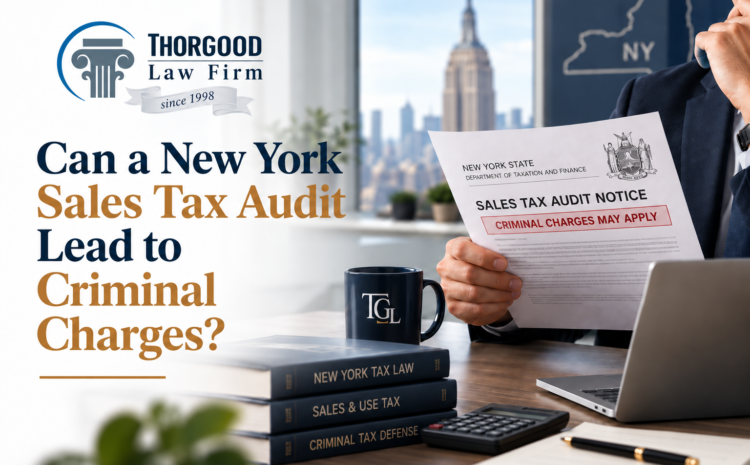
Receiving notice of a New York State sales tax audit does not mean that you are under criminal investigation.
Most New York sales tax audits are civil examinations. The New York State Department of Taxation and Finance audits businesses to determine whether they properly reported taxable sales, collected the correct amount of sales tax, and remitted the tax that was due.
However, a routine sales tax audit can become much more serious if the auditor discovers evidence suggesting that the business intentionally concealed sales, filed false returns, failed to remit sales tax collected from customers, submitted false information during the audit, or otherwise engaged in willful conduct designed to evade tax.
New York’s Tax Law specifically makes certain willful conduct involving sales tax a tax fraud act, and criminal tax fraud offenses can range from misdemeanors to serious felonies depending upon the conduct and amount of tax involved.
For a business owner facing a sales tax audit, understanding the difference between a civil tax problem and potential criminal exposure can be critically important.
Most New York Sales Tax Audits Are Civil
An audit ordinarily begins as a civil examination.
The auditor may request records such as:
- sales journals;
- point-of-sale records;
- bank statements;
- credit-card processing statements;
- purchase invoices;
- general ledgers;
- federal and state tax returns;
- exemption and resale certificates; and
- other records relating to the business’s sales.
The auditor’s objective is generally to determine whether the business reported and paid the correct amount of tax.
If the auditor finds mistakes, the result may simply be an assessment of additional sales tax, penalties, and interest.
For example, a business may have mistakenly treated certain transactions as exempt when they were taxable. It may have accepted defective resale certificates. Its accounting system may have incorrectly categorized transactions.
Those types of problems do not automatically constitute tax crimes.
The critical distinction is often intent.
What Turns a Sales Tax Problem Into a Potential Criminal Case?
New York Tax Law § 1801 identifies a number of acts that can constitute “tax fraud acts” when performed willfully.
Those acts include, among other things:
- failing to file a required tax return;
- knowingly filing a return containing materially false or fraudulent information or omitting material information;
- knowingly submitting false information during an audit or investigation;
- engaging in a scheme to defraud the State concerning tax;
- failing to remit tax collected on behalf of the State;
- failing to collect tax required to be collected; and
- failing to pay tax with the intent to evade it.
The word “willfully” matters.
There is a significant difference between making an accounting mistake and intentionally concealing taxable sales.
For example:
A restaurant owner whose bookkeeper accidentally misclassified certain transactions presents one type of case.
A restaurant owner who knowingly deletes cash transactions from the POS system before filing sales tax returns presents a very different one.
- Intentionally Underreporting Cash Sales
Cash-intensive businesses can receive particular scrutiny during sales tax audits.
Restaurants, bars, delis, retail stores, salons, auto-related businesses, and other businesses that receive significant cash payments may face questions concerning whether all cash receipts were recorded.
A discrepancy between reported sales and other information does not automatically establish criminal conduct.
But circumstances may become more serious where evidence suggests a deliberate system for concealing cash sales.
Examples might include:
- maintaining a second set of records;
- deleting cash transactions;
- manipulating POS data;
- directing employees not to record certain sales;
- maintaining undisclosed bank accounts; or
- knowingly reporting only part of actual receipts.
Those facts potentially suggest something more than inaccurate bookkeeping.
- Collecting Sales Tax but Not Paying It to New York
This is another particularly serious issue.
A business may properly charge customers sales tax but then fail to remit the collected money to New York State.
New York Tax Law § 1801 expressly identifies the willful failure to remit tax collected on behalf of the State as a tax fraud act.
The Tax Department likewise advises that a person may be subject to fines and imprisonment for willfully failing to remit state and local taxes collected.
That does not mean every business that falls behind on sales tax payments will be criminally prosecuted.
A business may encounter serious financial hardship and use money that should have been remitted to pay payroll, suppliers, rent, or other expenses.
But where collected sales tax remains unpaid over multiple filing periods, particularly where the owner knew the tax was due, the potential criminal implications should be taken seriously.
- Filing False Sales Tax Returns
Another warning sign is evidence that filed returns were knowingly inaccurate.
Tax Law § 1801 includes knowingly filing or submitting a return or other document that contains materially false or fraudulent information or omits material information.
Consider a business whose records show $2 million in sales but whose owner knowingly reports only $1.2 million.
That raises materially different issues from a business whose return contained a computational error.
Evidence of repeated understatement can be particularly significant when combined with other evidence suggesting intentional concealment.
- Providing False Information During the Audit
A business owner should also be careful about what happens during the audit.
New York’s criminal tax provisions do not apply only to the original tax return.
Tax Law § 1801 also addresses knowingly providing materially false or fraudulent information in connection with an audit, investigation, or proceeding.
That means attempting to “fix” a bad situation by creating false records can make matters substantially worse.
A taxpayer should never fabricate invoices, alter bank records, create false exemption certificates, backdate documents, or provide an auditor with information known to be false.
If records are missing, it is generally better to address the missing-record problem honestly than to manufacture documents that did not previously exist.
- Destroying or Manipulating Business Records
New York requires sales tax vendors to maintain records sufficient to verify their sales tax reporting.
The Tax Department states that willful failure to maintain required sales tax records can result in criminal penalties.
Missing records alone do not prove criminal intent.
Records may disappear because a POS provider changed, a computer failed, an employee failed to preserve them, or the business simply maintained poor records.
But deliberately destroying or altering records after learning of an audit presents a much more serious situation.
Can an Audit Be Referred for Criminal Investigation?
Potentially.
The Department of Taxation and Finance performs not only audits and collections but also criminal investigations as part of its enforcement activities.
A civil auditor discovering facts suggesting intentional tax fraud may therefore create risks beyond an additional civil assessment.
A business owner should pay attention if the tone or nature of the inquiry changes.
Possible warning signs can include unusual emphasis on:
- who personally prepared returns;
- who knew the sales figures;
- who controlled bank accounts;
- what happened to collected sales tax;
- whether records were deliberately deleted;
- why particular sales were omitted;
- who directed employees regarding cash transactions; or
- whether particular statements previously made to the Department were true.
No single question proves that a criminal investigation exists. But a taxpayer facing facts that could reasonably suggest intentional wrongdoing should consider obtaining legal counsel before making substantive statements.
What Are New York’s Criminal Tax Fraud Charges?
New York Tax Law Article 37 creates several degrees of criminal tax fraud.
Criminal tax fraud can range from criminal tax fraud in the fifth degree through criminal tax fraud in the first degree.
The degree depends in part upon the amount of tax involved and other statutory elements.
For example, the monetary thresholds increase through the felony levels. Criminal tax fraud in the fourth degree involves more than $3,000 of underpaid tax within the applicable period; third degree involves more than $10,000; second degree involves more than $50,000; and first degree involves more than $1 million.
New York law also permits certain unpaid tax liabilities arising within one year to be aggregated for criminal tax fraud purposes.
For a business with recurring quarterly sales tax obligations, that can be important.
Can the Owner Be Charged Personally?
Potentially, yes.
A corporation or LLC does not provide a shield against personal criminal responsibility for an individual’s own conduct.
If an owner personally directs the filing of false returns, intentionally conceals sales, or knowingly participates in another tax fraud act, the fact that the business operates through a legal entity does not necessarily insulate that individual from criminal exposure.
Separate from criminal liability, New York sales tax law can also impose civil responsible-person liability on individuals associated with the business.
Thus, a serious sales tax case may involve several different forms of exposure:
business tax liability;
civil penalties;
personal responsible-person liability;
and potentially criminal tax liability.
Those issues should be analyzed separately.
Does an Inadequate-Records Finding Mean the Case Is Criminal?
No.
This distinction is important.
The Department may determine during a civil audit that a business’s books and records are inadequate and use an estimated audit methodology to calculate taxable sales.
That alone does not mean the business committed tax fraud.
Businesses often have poor records without criminal intent.
However, the reason the records are missing can matter.
There is an important difference between:
“Our POS provider no longer has transaction-level information from three years ago.”
and:
“We intentionally deleted cash transactions before giving the POS records to the auditor.”
Both situations involve missing information, but only the latter inherently suggests deliberate concealment.
What If the Auditor’s Estimate Is Much Higher Than Your Reported Sales?
A large estimated assessment also does not automatically establish fraud.
When records are inadequate, the Department may reconstruct taxable sales using purchase markups, observation tests, credit-card information, statistical sampling, or other indirect methodologies.
The estimate might show substantially greater sales than the business reported.
That may produce significant civil liability.
But the fact that the Department estimated additional sales does not, standing alone, establish that the business owner intentionally evaded tax.
A taxpayer may have legitimate grounds to challenge the auditor’s assumptions or methodology.
Should You Speak With the Auditor if Criminal Exposure Is Possible?
This is an area where caution can be important.
In an ordinary civil audit, cooperation and communication with the auditor are generally part of the process.
But if the known facts include substantial intentionally unreported sales, collected but unremitted sales tax, false returns, altered records, or other potentially willful conduct, a business owner should consider obtaining legal advice before participating in substantive interviews.
Statements made to the Department can become important evidence.
Unlike communications with an attorney, communications with an accountant generally do not carry the same broad attorney-client privilege.
When criminal exposure is a realistic possibility, retaining counsel early can therefore materially affect how the audit is handled.
What Should You Do If You Are Concerned About Criminal Exposure?
First, do not alter or destroy records.
Preserve POS information, bank statements, sales records, returns, emails, accounting files, merchant-processing records, and other relevant documents.
Second, determine the actual scope of the problem.
Questions to examine include:
- Were all sales tax returns filed?
- Were the reported sales accurate?
- Was sales tax collected but not remitted?
- How much tax is potentially involved?
- Over what period?
- Who prepared the returns?
- Who knew about the unpaid liability?
- Were records altered or destroyed?
- Has the Department already identified discrepancies?
Third, consider legal representation before providing additional explanations if the facts may support an allegation of intentional conduct.
The strategy appropriate for a routine civil audit may not be appropriate where criminal exposure exists.
Can Voluntary Disclosure Help?
In some circumstances, New York’s Voluntary Disclosure and Compliance Program may allow eligible taxpayers with undisclosed liabilities to avoid monetary penalties and possible criminal charges.
However, eligibility requirements apply, and taxpayers who are already under audit or investigation for the tax and period involved may not qualify.
The Tax Department currently describes voluntary disclosure as a program through which qualifying taxpayers with unpaid taxes may obtain relief from monetary penalties and possible criminal charges.
For that reason, taxpayers with unreported sales tax problems should consider their options before the Department initiates an audit or investigation.
Speak With a New York Criminal Tax Attorney
A New York sales tax audit does not automatically mean criminal charges are coming.
But if the audit uncovers evidence of deliberately unreported sales, collected but unremitted sales tax, false returns, manipulated records, or intentionally false statements, the consequences can become substantially more serious than an ordinary tax assessment.
At Thorgood Law Firm, we represent businesses and individuals in New York State sales tax audits, responsible-person assessments, civil fraud matters, tax appeals, and criminal tax investigations.
If you are concerned that a New York sales tax audit may involve potential criminal exposure, contact Thorgood Law Firm to discuss your situation before making additional statements or providing information that may affect your rights.
Frequently Asked Questions
Can a New York sales tax audit become a criminal investigation?
Yes. Most sales tax audits are civil, but evidence suggesting willful tax fraud—including intentionally concealed sales, false returns, failure to remit collected sales tax, or false information supplied during an audit—can potentially result in criminal investigation or prosecution.
Does owing New York sales tax mean I committed a crime?
No. Owing tax does not by itself establish criminal conduct. Mistakes, disputed taxability, incomplete records, or inability to pay may result in civil liability without criminal intent.
Is failing to remit collected sales tax a crime?
It can be. New York Tax Law identifies willful failure to remit tax collected on behalf of the State as a tax fraud act. Whether criminal liability exists depends on the facts and required proof of willful conduct and other statutory elements.
Can unreported cash sales result in criminal charges?
Potentially. Unreported cash sales alone require factual analysis, but deliberate concealment of cash transactions or knowingly filing returns that materially understate sales can create criminal tax exposure.
Can I get in criminal trouble for giving false information to a sales tax auditor?
Yes. New York Tax Law includes knowingly supplying materially false or fraudulent information in connection with an audit, investigation, or proceeding among the acts that can constitute tax fraud.
Does having inadequate business records mean I committed tax fraud?
No. Inadequate records alone do not prove fraud. However, deliberately destroying, altering, or concealing records can create much more serious issues.
Can New York aggregate unpaid sales tax for criminal charges?
Yes. New York’s criminal tax provisions permit certain underpaid tax liabilities arising within a one-year period to be aggregated when applying criminal tax fraud provisions.
Should I speak with an attorney if I think a sales tax audit could become criminal?
Yes, legal advice should be seriously considered where the facts involve intentionally unreported sales, substantial collected but unremitted tax, potentially false returns, altered records, or questions from the Department suggesting intentional wrongdoing.
Can New York’s Voluntary Disclosure Program prevent criminal charges?
For qualifying taxpayers, New York’s Voluntary Disclosure and Compliance Program may provide protection from monetary penalties and possible criminal prosecution. Eligibility restrictions apply, and taxpayers already contacted about the liability may not qualify.